3.1 - Elliott Wave — Impulse Waves
The Complete Cycle
One complete cycle = 8 waves:
- Motive phase (5 waves): Labelled with NUMBERS (1, 2, 3, 4, 5) — moves in the direction of the trend
- Corrective phase (3 waves): Labelled with LETTERS (A, B, C) — moves against the trend
Quick identifier: Numbers = motive (with the trend). Letters = corrective (against the trend).
The motive phase contains three types: impulse waves (most common, covered here), extended waves (covered next), and diagonal waves (covered after that).
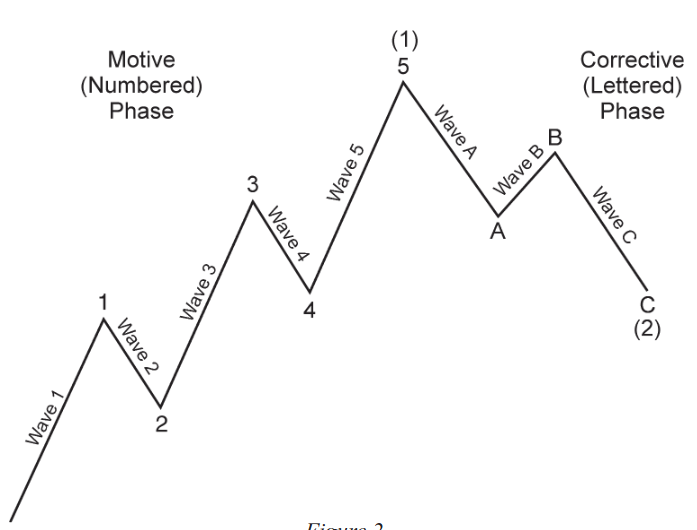
The Five Impulse Waves
Wave 1 — The Initial Move (Accumulation)
- Marks the beginning of a new trend, often after the previous trend has exhausted
- Rarely obvious at inception — sentiment is still bearish from the prior downtrend
- Lower investor confidence, market hasn't fully shifted yet
- Volume may be relatively low (sometimes high if institutional money enters)
- Often targets the zag zone of the previous correction (382, 500, or 618), or a 1:1 of the previous corrective wave, or 61.8% of the previous correction
- This is where you get your failure swings, non-failure swings, and inverse head & shoulders — the reversal patterns from the foundational course
Wave 2 — Deep Correction
- Corrects wave 1 but CANNOT retrace beyond the starting point of wave 1 (Rule #1 — not even by one cent, not even a wick)
- Typically a deep retracement: 50-61.8%, sometimes 78.6%
- Sentiment is still bearish — everyone thinks the bear market is still intact ("just another lower high")
- Volume tends to decrease (corrective move, lower participation)
- Often looks sharp and steep
- If wave 2 goes below the start of wave 1 → the count is INVALIDATED. Start over
Wave 3 — The Strongest Wave (Public Participation)
- Typically the most powerful and extended wave (in equities — in commodities, wave 5 can be larger)
- Strong market sentiment and widespread participation
- Sharp and rapid price increase with high volume
- Corrections within wave 3 are short-lived and shallow — anyone waiting for a pullback misses the boat
- The centre of wave 3 often looks nearly vertical
- Cannot be the shortest of waves 1, 3, and 5 (Rule #2 — doesn't have to be the longest, just can't be the shortest)
- Common Fibonacci extension targets from wave 1: 1.618 (most common, ~60-70% of the time), 2.0, 2.618, or even higher in strong trends. Can also be 1.0 (equal to wave 1) in weaker trends
Wave 4 — Shallow Correction
- Corrects wave 3 — usually less severe than wave 2
- Often takes the form of sideways consolidation (triangles, flats, choppy action)
- Cannot overlap with the price territory of wave 1 (Rule #3 — exception: diagonal patterns)
- Typically a shallow retracement: 23.6-38.2%, sometimes 50%. Rarely 61.8% (would risk overlapping wave 1)
- Volume well below wave 3
- Often frustrating — takes a long time, goes nowhere. "If you're feeling lost, you're probably in wave 4"
- Good place to buy a pullback if you understand wave 5 is coming
Wave 5 — The Final Push (Excess)
- Last wave in the impulse sequence — driven by the final burst of enthusiasm
- News is universally positive, everyone is bullish
- Often shows divergence on RSI (weakening momentum from wave 3 to wave 5)
- Volume may decline compared to wave 3 — suggests trend exhaustion
- Average investors finally buy in right before the top
- Can sometimes truncate — fail to move beyond the end of wave 3 (double top, then reversal)
The Three Cardinal Rules (CANNOT Be Broken)
| Rule | Description | If Violated |
|---|---|---|
| 1. Wave 2 cannot retrace more than 100% of wave 1 | Wave 2 cannot go below the starting point of wave 1 — not even by one cent | Wave count is invalidated — re-evaluate |
| 2. Wave 3 cannot be the shortest | Wave 3 doesn't have to be the longest, but it cannot be shorter than BOTH wave 1 and wave 5 | Wave count is invalidated — re-evaluate |
| 3. Wave 4 cannot overlap wave 1 | Wave 4 cannot enter the price territory of wave 1 (exception: diagonal patterns) | If not a diagonal, wave count is invalidated |
Additional Guidelines (Common But Not Mandatory)
Wave Extension: Usually one impulse wave (typically wave 3) will be significantly longer than the others. ~80-90% of impulse waves have at least one extended wave.
Truncation: Wave 5 sometimes fails to surpass wave 3 — creates a double top before reversing. Still a valid 5-wave count, just with a truncated wave 5.
Channels: Impulse waves often fit within parallel trend channels. Drawing a channel from wave 1 to wave 2, parallel to wave 3, can help identify wave 4 targets and wave 5 projections.
Alternation Rule: If wave 2 is simple/sharp (deep zigzag), expect wave 4 to be complex/sideways (flat, triangle). If wave 2 is complex, expect wave 4 to be simple. They should NOT look the same. This helps you anticipate what type of correction wave 4 will be based on what wave 2 looked like.
Fibonacci Targets for Each Wave
Wave 1 Targets
- 100% of the previous corrective wave (1:1)
- 61.8% of the previous corrective wave
- 38.2-61.8% retracement of the previous impulse (the zag zone)
Wave 2 Retracement Levels
- 38.2% — shallow, indicates very strong trend (less common for wave 2)
- 50% — moderate correction
- 61.8% — most common for wave 2 (deep correction, sentiment still bearish)
- 78.6% — deep but still valid (cannot reach 100%)
Wave 3 Extension Targets (from wave 1)
- 1.618 — the golden ratio, most common (~60-70% of the time)
- 2.0 — strong trends
- 2.618 — very strong trends
- 1.0 — equal to wave 1 (weaker trends — implies wave 5 must be small since wave 3 can't be shortest)
Wave 4 Retracement Levels (of wave 3)
- 23.6% — very shallow, strong trend
- 38.2% — typical for wave 4
- 50% — deeper but still common
- 61.8% — rare, risks overlapping wave 1 depending on the wave structure
Wave 5 Targets
- Equal to wave 1 — the most common target (especially when wave 3 was extended)
- 61.8% of waves 1+3 combined — very common. Measure wave 1 + wave 3 combined length, pull back to wave 4, project 61.8% = wave 5 target
- 1.618 of waves 1+3 combined — for extended wave 5s (common in commodities)
- 100% of wave 3 — less common, occurs in strong trends
- Real examples: The educator called the exact top on Lake Resources using the 1.618 of waves 1+3 combined, and CXO using the 1:1
Tips for Recognising Impulse Waves (Shane's Guide)
- Wave 2 is usually steep — the retracement looks quite sharp and strong
- Wave 3 is very easy to recognise — almost always increased volume, gaps, bullish technical indicators. Looks very sharp and strong with a high slope. The centre of wave 3 seems to have "vertical" signs
- Wave 4 makes a shallow retracement compared to wave 3. Seems to take longer, and the retracement is not as deep or strong as wave 2
- Wave 5 is less powerful and steeper than wave 3. Easier to find because it takes longer and moves shorter. Comes after wave 4 (the shallow, time-consuming correction)
Strategy: Focus on Corrections
The strategy is NOT to trade the impulse waves directly — it's to focus on corrective waves (waves 2, 4, and ABC), because those are the SIGNALS that tell you when to enter for the next motive wave. Identify how corrections develop, wait for them to complete, then position for the next impulse.
"Following these corrective waves, there are always opportunities with the next Motive Waves. So our strategy is to focus on corrective waves — they will be Signals for us to trade."